Notes
Back to articles
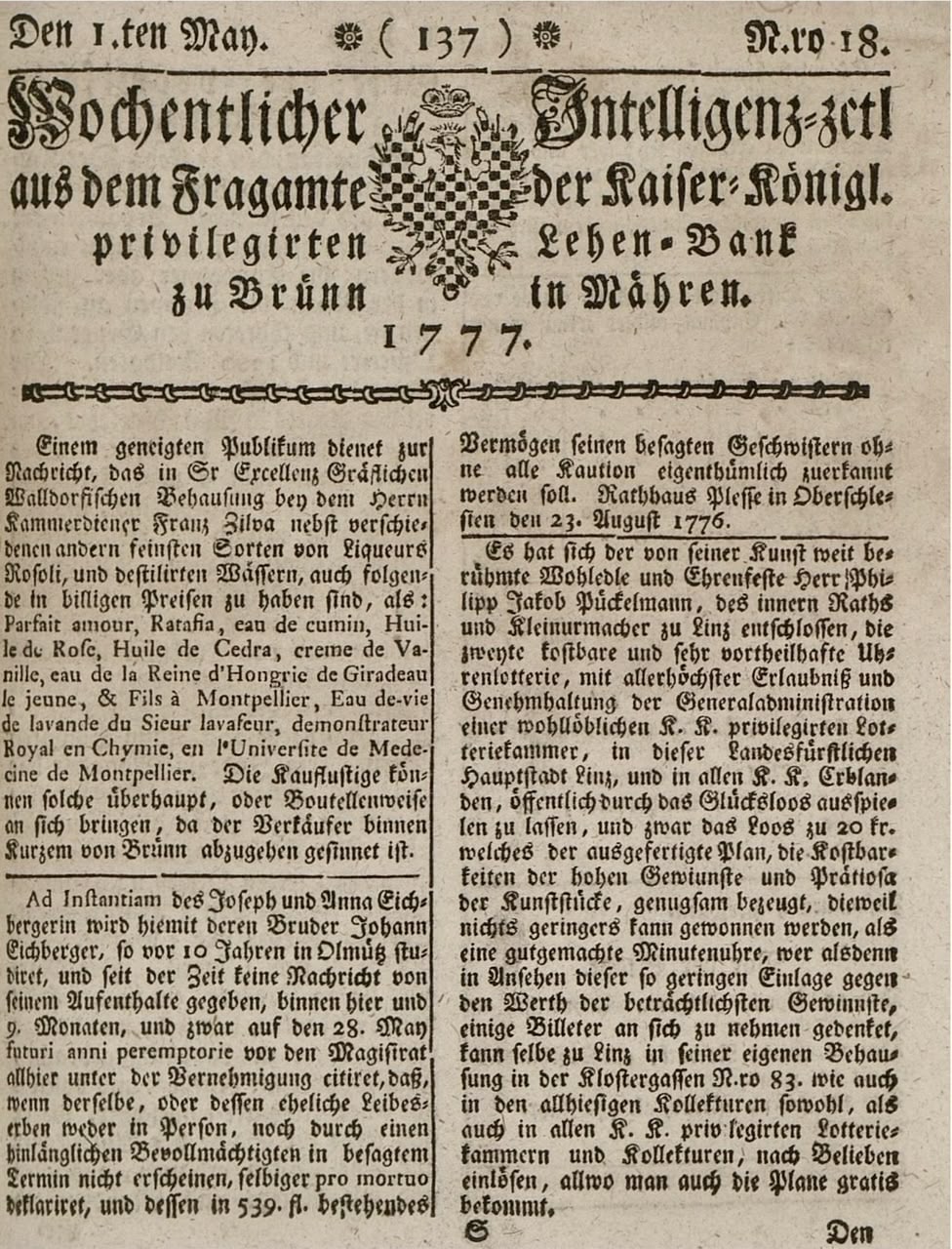
One of the oldest surviving mentions of Parfait d’Amour liqueur in our lands was printed on 1 March 1777 by the weekly news bulletin of the Royal Privileged Bank of the Virgin Mary in Brno. The report makes it clear that the liqueur must have been not only known and popular here, but apparently also highly sought after.
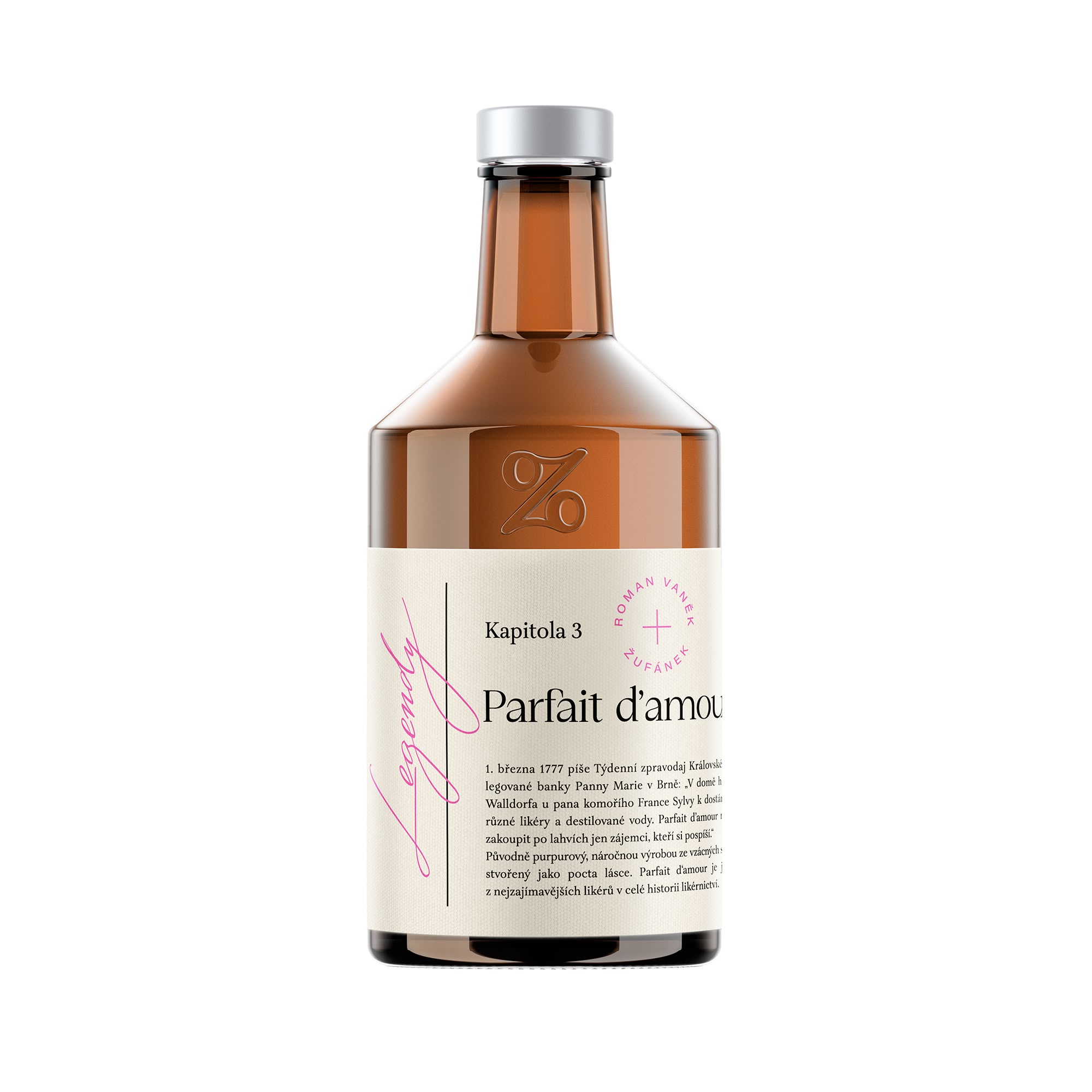
Parfait d’Amour, a liqueur with a rich history reaching back more than two centuries, tells the story of a drink that conquered the world. Among the liqueurs of its time it stood out not only for its original purple colour, but also for its exceptionally demanding production and costly ingredients – it used rare or hard-to-obtain raw materials, which is obvious at first glance from the oldest recipes.
Historical recipes varied considerably. Different periods and producers brought their own variations, shaped not only by the taste of the time but also by the availability of ingredients – rose petals, for instance, were expensive, and producers had to compete with perfumers for them. Over time the original recipe was simplified and costly ingredients were replaced by cheaper ones. Even so, Parfait d’Amour managed to keep its exceptional standing and spread all over the world.
As part of our Liquid Legends project, we went through a large number of historical materials and tested various period recipes and shades of the liqueur. Many of them didn't address the exact colour at all, which forced us to keep looking. Then, quite by chance, while working with archive materials from the collections of Roman Vaňek, we came across three short notes supplementing the recipes that we had previously overlooked. Yet they held the whole original essence of the liqueur.
The discovery was fundamental: the original Parfait d’Amour was not a violet, distinctly sweet liqueur dominated by the scent of violets and vanilla, as many people still subconsciously think of it – a "ladies' liqueur", a tribute to women. That is a mistake. The original intention was to create a liqueur as a tribute to love in general – love for others, love between people, harmony with one's surroundings.
And that is exactly why the purple colour – bold, dignified, but not sentimental. And that is exactly why the breathtaking harmony of flavours that we managed to put back together after completing our tests based on the oldest recipes.
Thanks to the Liquid Legends project, we now offer the chance to taste Parfait d’Amour as it tasted at the very beginning of its history – in its original purple colour, with a rich, complex flavour made of costly and rare ingredients. A tribute to true love in its purest form.
The liqueur's flavour and aroma are defined by orange, lemon, bitter almonds, orange blossom, rose petals and more.
Parfait d’Amour – A tribute to Karl Napoleon Balling
Parfait d’Amour is the third liqueur in the Liquid Legends collection. Like the previous two, it is dedicated to a figure who left an indelible mark on Czech culinary history. In this case, on world history too. We dedicate Parfait d’Amour to Professor Karl Napoleon Balling (1805–1868), a chemist, teacher and visionary whose work changed the way we understand fermentation and the quality of beverages.
Balling worked at the Prague Polytechnic, where he was appointed professor of general and technical chemistry in 1835 and served as rector in 1865–1866. He was instrumental in systematising the teaching of chemistry, founding a technical library and introducing lectures on brewing, sugar production and fermentation chemistry.
His best-known contribution is the invention of the saccharometer (Balling's sugar meter) and the creation of the Balling scale, which made it possible to measure the density of sugar solutions precisely. The scale became the basis for determining the strength of beer, but also for monitoring fermentation and the quality of raw materials in distilling, brewing and sugar production.
Balling is considered the founder of modern fermentation chemistry. He developed the theory of attenuation, defined the difference between apparent and real attenuation, and with his approach connected science with production practice.
This Parfait d’Amour tribute to him is therefore a tribute to a man who brought precision, analysis and a deep understanding of raw materials to the world of beverages. A man who believed that harmony of flavour begins with knowledge of the processes – just as in this liqueur, which you can now taste in its historical form as the third completed chapter in our imaginary book of Liquid Legends.
As with the previous two chapters, once it sells out, no further edition will be made. The total run is 1,000 bottles.
On sale from the second half of January 2026.